Draft
Record the research work that will become a manuscript.
Track every manuscript from preparation through to its editorial outcome. KaiperKit brings authors, journal, DOI, tasks and deadlines together around the paper and connects it to the projects and research lines that gave rise to it.
Start with the free plan. No card required. Academic publication tracking for researchers and R&D teams.
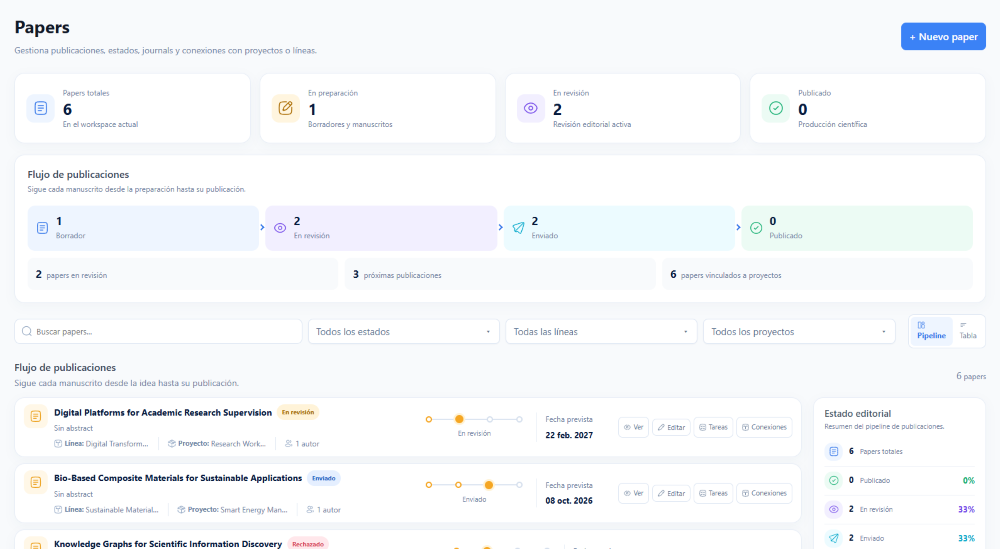
An academic publication begins before it has a DOI. There is a manuscript proposal, authors, a target journal, writing tasks, internal reviews and deadlines to meet. When this information is scattered across spreadsheets and messages, it is difficult to know what is happening with each paper.
KaiperKit records the paper as part of the research: a record containing its status and editorial information, connected to people, work and scientific entities. This lets you view both a manuscript in preparation and a completed publication.
The essential scientific information remains in a recognisable record.
The team can see where the manuscript stands and what work remains open.
Complete the record when the article is published and these details are available.
Tracking scientific manuscripts means distinguishing between work in preparation, work under team review, submissions sent to a journal and papers that have already been published. KaiperKit lets you record explicit statuses and review the paper portfolio without reconstructing it from email.
Record the research work that will become a manuscript.
Coordinate internal revisions, assigned people, tasks and deadlines.
Keep the scientific and editorial context of the submission in its record.
Add the DOI and publication date when they become available.
You can also record the status “Rejected”. These statuses describe tracking within KaiperKit: the platform does not submit the manuscript to the journal or automatically synchronise editorial decisions.
Editorial information, team coordination and research context in the same record.
Title, abstract, status, journal, DOI and date to identify the manuscript and track its progress.
Record the paper's authors and assign workspace members to coordinate its progress. Scientific authorship and permissions are separate concepts.
Link reviews, revisions and deliverables to the publication, with responsible members, priorities and dates where applicable.
Associate document references with the paper by URL to find protocols, resources or supporting materials from within its context.
Connect the paper to related projects, research lines, theses and conferences.
View recorded papers by status and return to their tasks, connections and responsible members from the list.
A paper can have scientific authors, group members coordinating the work and collaborators contributing to specific tasks. KaiperKit lets you record authorship and connect workspace members to the publication.
Record the authors of each publication and assign team members to track its progress. Identify who is involved and distribute the preparation, review and delivery tasks.
People listed as authors in the publication record.
Users connected to operational tracking within the workspace.
A list of titles is not enough to understand a group's scientific output. The connection to a project shows where the results were generated; the research line identifies the strategic area; and a thesis or conference can provide further context.
Relationships are recorded explicitly in KaiperKit. Each entity retains its own information, and the paper no longer appears as an isolated bibliographic reference.
Explore project managementIllustrative example of relationships created by the team.
KaiperKit supports the team's publication management process: see which papers are active, which research they belong to, who is involved, what tasks remain pending and which editorial details have been recorded.
It is not a manuscript editor, reference manager or journal submission platform. Documents are referenced by URL; files are not uploaded or synchronised from this module.
The information depends on what the team records and keeps up to date.
How an academic publication is recorded and what work can be connected to it.
Yes. You can create its record during preparation and add the journal, DOI or publication date when they become available.
Yes. The recorded statuses reflect where the paper stands, including the status “Rejected”. The team updates this information.
Yes. It can be connected directly to projects and research lines, as well as theses and conferences.
Yes. Tasks and deadlines linked to the paper retain their responsible members, status and dates within that scientific context.
No. KaiperKit organises the record, relationships and work tracking. Document references are linked by URL; writing and editorial submission take place in the appropriate tools.
We will show you how to track papers, authors, reviews and dates alongside the project and research line that provide their context.